A Journey of Language and Discovery, Inspired by Reggio Emilia and Montessori
At our school, the English Department is the vibrant heart of our bilingual immersion programme for children in Early Years and Primary. Our unique approach blends two powerful, child-centered philosophies: Reggio Emilia’s collaborative, project-based inquiry, and the structured, independent growth fostered by the Montessori Method.
This synergy lets us see language not just as a subject to study, but as a living, dynamic tool for independent exploration, creative expression, and meaningful connection with the world.
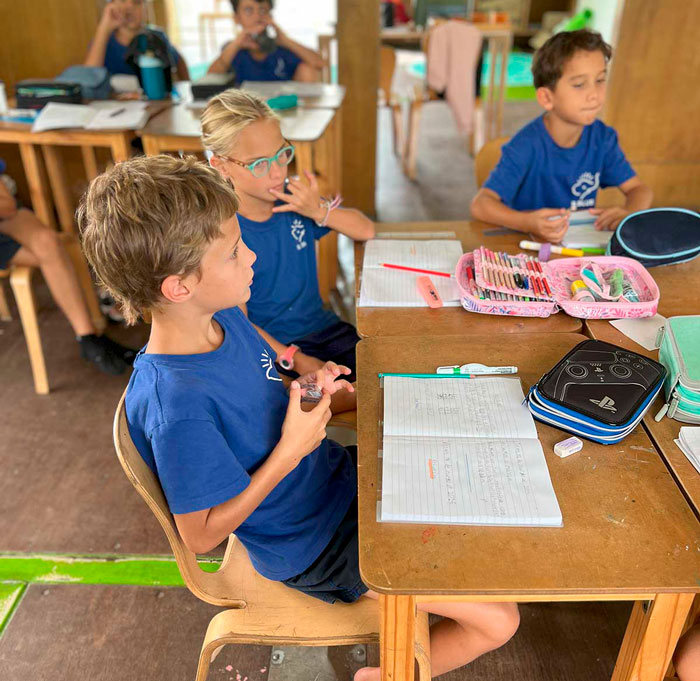
The Child at the Center of a Language Adventure
We believe every child is a capable, curious communicator, full of potential.
Our approach is deeply child-centered: learning grows from each child’s own interests, questions, and ideas. English is acquired naturally and experientially, through a stimulating environment we call “the third teacher.”
Interdisciplinary, Project-Based Learning
Our curriculum is built around interdisciplinary projects that bring together language, science, art, and intercultural inquiry. This holistic vision ensures language development is always meaningful and deeply connected to real-world concepts.
Building Communication Skills and Global Citizenship
Building Communication Skills and Global Citizenship
We offer endless opportunities for experiential learning, so students can:
- Expand their vocabulary through authentic, real-world contexts.
- Develop a love of reading through our library and literature circles.
- Sharpen communication skills through collaboration, debate, and public speaking.
- Build reflection and critical thinking by documenting and revisiting their own learning journey.
- Foster intercultural understanding by connecting with ideas and perspectives from the English-speaking world.
A Close-Knit Learning Community
Our department works as one connected community, where teachers, facilitators, and students learn together. Collaboration isn’t just a skill we teach — it’s the foundation of our classroom culture. We work as a team to investigate, solve problems, and celebrate every step of the learning journey.
Natural Preparation for Trinity College London Exams
Our project-based, communication-driven environment organically builds the very skills assessed in Trinity College London’s GESE exams. Our students prepare not through rote repetition, but through genuine language mastery — speaking with confidence, sharing their opinions, and presenting their projects and interests with fluency and self-assurance.
In short, our English Department offers a caring, stimulating ecosystem where children grow into enthusiastic, thoughtful, and collaborative English speakers — fully prepared for the opportunities of a global future.
Every Child, a Capable Crew Member
Guided by the Reggio Emilia philosophy, we see every child as a skilled navigator of their own learning. Their natural curiosity about oceans, ships, and faraway places drives the curriculum. We hoist the sails — but it’s the children who help chart the course of our inquiry, guided by their own questions and interests.
An Interdisciplinary Voyage of Discovery
The Clipper Race is far more than a sailing competition — it’s a rich tapestry of learning that naturally weaves together multiple disciplines:
- Geography and culture: We follow the race route in real time, exploring maps, oceans, and continents. Children research the cultures, flags, languages, and symbols of each port city (London, Sanya, Cape Town, New York, and more).
- Science and technology: Students become marine scientists and engineers, exploring concepts like buoyancy, wind energy, and weather patterns. They study how a boat moves, design and build their own models, and learn about the marine ecosystems along the race route.
- Values education: The race is a powerful lesson in teamwork, resilience, and courage. Children learn about collaborating within a diverse crew, overcoming major challenges, and the importance of safety and determination — values we cultivate throughout our school community.
- Language and communication: Vocabulary expands with terms like hull, bow, stern, knot (speed), and navigation. Children document the journey, write postcards from each port, listen to stories from around the world, and present their findings — building communication confidence in both English and Spanish.
- History and math: We explore the history of exploration and trade routes. Math comes to life through hands-on work: calculating distances, measuring materials for building model boats, charting daily weather data, and understanding race schedules.
Learning as an Experiential Journey
This unit comes to life through hands-on, immersive experiences:
- Transforming the classroom into a “ship” or a “dock.”
- Building boats from recycled materials and testing them on water.
- Creating a large interactive map to follow the race.
- Role-playing as crew members, meteorologists, and cartographers.
- Tasting foods and listening to music from the countries visited.
One United Crew: Our Learning Community
Just like the crew of a Clipper racing yacht, our classroom works as one united team. Children collaborate on projects, share responsibilities, and celebrate each other’s discoveries. They build critical thinking by solving problems together and reflecting on their shared “voyage.”
This unit is a true reflection of who we are: children deeply engaged in a real, meaningful project that naturally and joyfully strengthens their language skills, academic knowledge, and personal values — preparing them to become true global citizens.